Automate Ansible Collection Testing with GitHub Actions
By Luca Berton · Published 2024-01-01 · Category: linux-administration
Learn how to automate testing for Ansible collections using GitHub Actions. This guide covers setting up .github/test.yml for reliable CI/CD and validation.
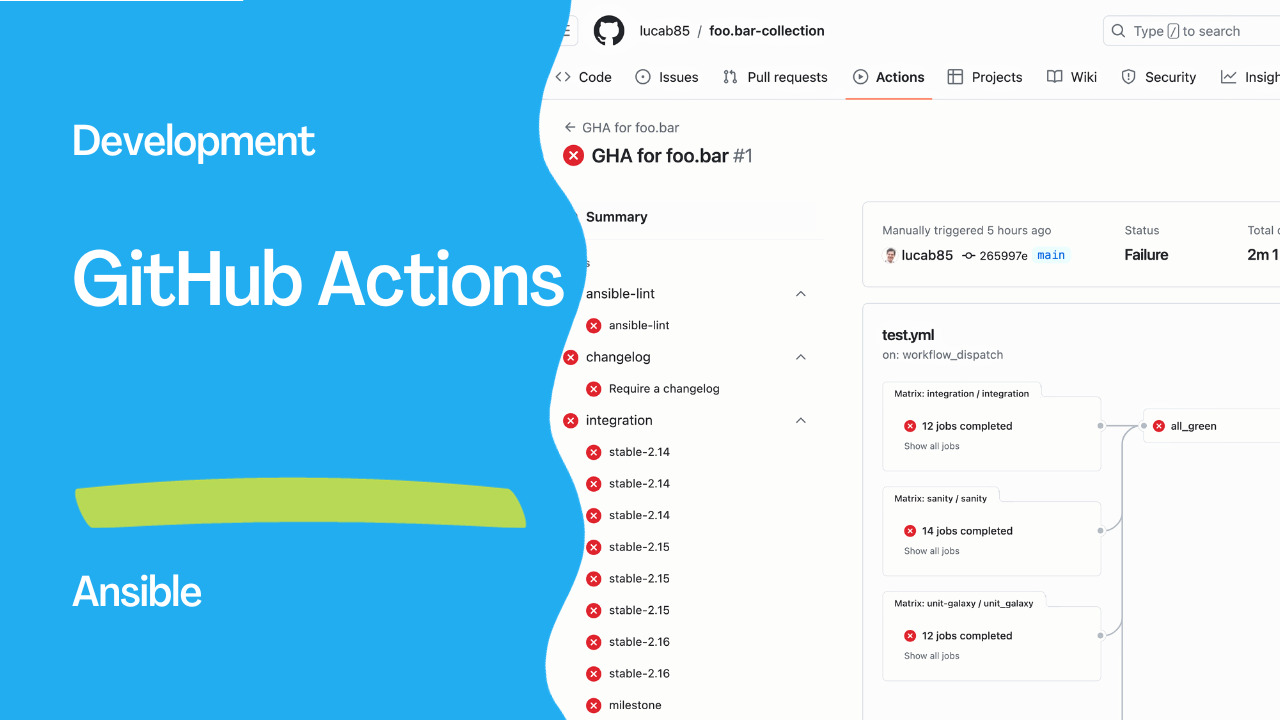
Introduction
GitHub Actions provides a powerful and flexible platform for automating workflows directly within your GitHub repository. One common use case is automating the testing of collections in Ansible, ensuring that each component functions as expected. This article will guide you through the setup of a GitHub Actions workflow for testing Ansible collections using the .github/test.yml configuration.
See also: Automate Ansible Galaxy Roles with GitHub Actions
Understanding the Configuration
Let's break down the structure of the .github/test.yml file:
name: GHA for foo.bar

concurrency:
  group: ${{ github.head_ref || github.run_id }}
  cancel-in-progress: true

on:
  pull_request:
    branches: [main]
  workflow_dispatch:
  schedule:
- cron: '0 0 * * *'- name: Describes the name of the GitHub Actions workflow.
- concurrency: Specifies concurrency settings, ensuring that workflows do not interfere with each other. The
groupattribute combines workflows under the same conditions, andcancel-in-progresscancels any currently running workflow if a new one is triggered.
- on: Defines the events that trigger the workflow. In this case, the workflow is triggered on pull requests targeting the
mainbranch, manually using workflow_dispatch, and on a daily schedule.
Now, let's look at the job definitions:
jobs:
  ansible-lint:
    uses: ansible-network/github_actions/.github/workflows/ansible-lint.yml@main
  changelog:
    uses: ansible-network/github_actions/.github/workflows/changelog.yml@main
  integration:
    uses: ansible-network/github_actions/.github/workflows/integration_simple.yml@main
  sanity:
    uses: ansible-network/github_actions/.github/workflows/sanity.yml@main
  unit-galaxy:
uses: ansible-network/github_actions/.github/workflows/unit_galaxy.yml@main- jobs: Lists the individual jobs that will be executed. Each job is defined separately and utilizes existing workflows from the
ansible-network/github_actionsrepository.
ansible-lint,changelog,integration,sanity, andunit-galaxyare examples of jobs that can be run independently.
all_green job:
  all_green:
    if: ${{ always() && (github.event_name != 'schedule') }}
    needs:
      - changelog
      - integration
      - sanity
      - unit-galaxy
    runs-on: ubuntu-latest
    steps:
      - run: >-
          python -c "assert set([
          '${{ needs.changelog.result }}',
          '${{ needs.integration.result }}',
          '${{ needs.sanity.result }}',
          '${{ needs.unit-galaxy.result }}'
]) == {'success'}"- all_green: This job runs only if certain conditions are met. It runs on the latest version of Ubuntu and depends on the successful completion of the
changelog,integration,sanity, andunit-galaxyjobs.
- steps: Specifies the steps to be executed within the job. In this case, it runs a Python script to assert that the results of the dependent jobs are all 'success'. If any job fails, the assertion will fail, and the workflow will not proceed.
Conclusion
By using the GitHub Actions workflow defined in the .github/test.yml file, you can automate the testing of Ansible collections, ensuring that changes to your repository are thoroughly validated. This setup promotes efficiency, consistency, and reliability in your development process. Feel free to customize the workflow to fit the specific needs of your project.
Related Articles
Category: linux-administration
Watch the video: Automate Ansible Collection Testing with GitHub Actions — Video Tutorial